
Financial Inclusion with a Sustainable Focus
Success stories of sustainable banking services pave the way for possible competitors and new players in the financial sector. There are few bigger success stories than Banco Familiar’s in Paraguay.


Success stories in sustainable banking show the way for potential competitors and new players in the financial sector. And there are few cases of greater success than that of Paraguay’s Banco Familiar.
Paraguay is one of the countries with the lowest levels of access to banking services in Latin America and the Caribbean (LAC), a region where low banking penetration is a widespread problem, with only a quarter of the adult population holding a bank account in a formal institution.
In this scenario, access to credit for micro, small and medium enterprises, or MSMEs, is not particularly thriving, as regulations are as harsh in Paraguay as they are in Ecuador and Chile, but substantially harsher than, for instance, in Peru and Bolivia.
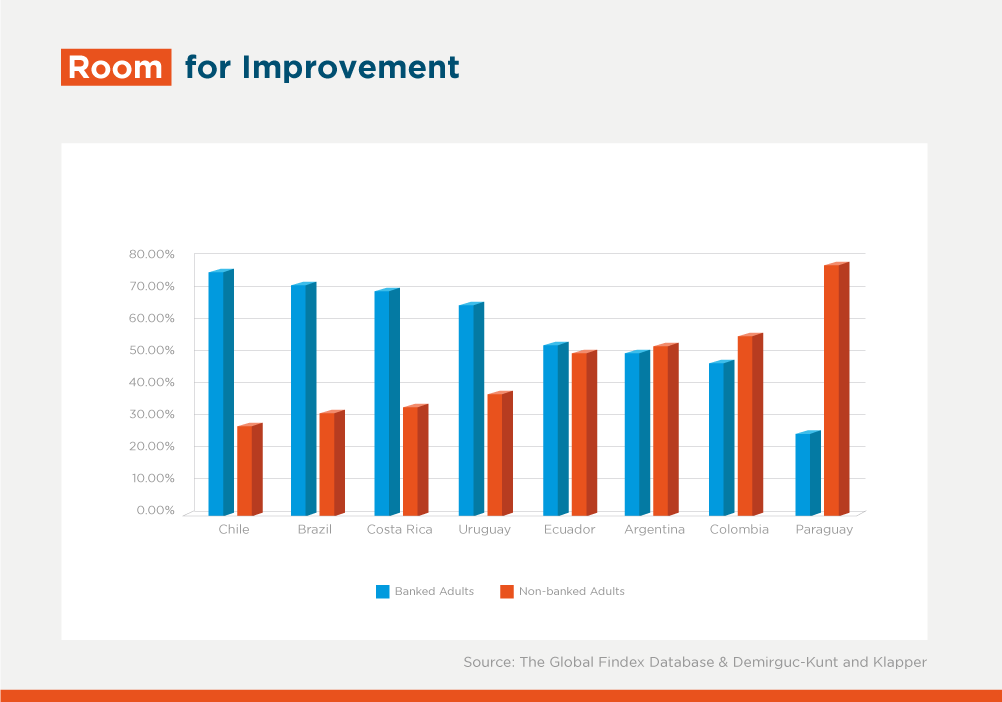
Banco Familiar, a niche bank focused on consumption loans for low-and-medium-income individuals and MSMEs, has been operating in Paraguay for over 50 years. It was founded in 1967 as Crédito Familiar and became a financial institution in 1992; in 2012, Familiar consolidated its position within the country’s financial system after acquiring financial institution Bríos. Even though Familiar holds a relatively low share in the domestic market, with 4.4% of private bank loans, it is one of top five players in the retail segment in Paraguay, mainly serving individuals and MSMEs.
Moreover, Familiar encourages financial inclusion by focusing on sectors that are not served by traditional banks. Familiar has thus played a major role in accelerating access to banking services in Paraguay. In the last decade, it has seen a fivefold increase in its client base, half of which did not have access to banking services before joining Familiar.
In fact, the last financial inclusion report reported by Paraguay’s central bank placed Banco Familiar as the lender with the highest number of debtors who are individuals in the Paraguayan system at the end of 2021, with more than 435,000 clients of this type.
In 2017, Banco Familiar got a partial guarantee from IDB Invest of up to 6 years denominated in local currency for the equivalent of $5 million for debt to be issued by the Instituto de Previsión Social (IPS) in Paraguay.
IDB Invest aimed to support Familiar’s expansion of its lending portfolio and contributed to its positioning as one of financial institutions with the largest involvement in sustainability and impact in the country. More specifically the terms were such that Banco Familiar could expand their lending portfolio in local currency for MSMEs and offer even longer credit terms.
As part of this support, IDB Invest also monitored Familiar’s Social and Environmental Management System to include international standards and comply with the local regulations for investments in agriculture, livestock and agribusiness. This requires Familiar to satellite monitor their clients in areas with high deforestation risks.
As a result of this deal, Familiar has also joined Paraguay’s Mesa de Finanzas Sostenibles, a platform where they collaborate with other operators of the Paraguayan financial system in promoting initiatives that help develop sustainable finance in the country.
(For more on the impact achieved by Banco Familiar, see this Client Impact DEBrief).
This blogpost is published in connection with IDB Invest Sustainability Week 2022, to be held between June 28 and July 1 in the city of Miami. Learn here how to register to participate, either in person or virtually.
Authors

Marielle del Valle
Senior Development Effectiveness Officer at IDB Invest. She works on the structuring, supervision and evaluation of projects with financial intermediaries and investments funds, and of trade finance operations, ensuring they promote social and economic benefits for the region. Prior to joining IDB Invest she worked as a consultant in the Office of Strategic Planning and Development Effectiveness and the Vice presidency of Countries of the Inter-American Development Bank (IDB), and as senior economic specialist at the Central Bank of Peru.

Almudena Carrasco
Almudena Carrasco is a Portfolio Management Officer specialized in financial institutions at BID Invest, where she monitors the execution of loans, guarantees, equity investments, short-term trade lines and structured products in countries throughout the region. She has over 10 years of experience in portfolio management, although she has been at the IDB Group for almost 20 years. Almudena holds a B.S. in Finance and International Business from University of Maryland and an M.S. in Finance from John’s Hopkins University.
LIKE WHAT YOU JUST READ?
Subscribe to our mailing list to stay informed on the latest IDB Invest news, blog posts, upcoming events, and to learn more about specific areas of interest.
SubscribeEnergy
Related Posts

Latin America and the Caribbean at the forefront of energy and technological progress
The region is rich in essential minerals and has the potential to develop its value chains. Countries must overcome several challenges to take advantage of these resources and their benefits. This requires transparency, governance, and attracting private investment.

We Helped a Solar Plant Hire More Women. Will the Industry Follow Suit?
The Lucayas Solar Power Project in the Bahamas marked a milestone by pioneering the integration of women in the construction of solar photovoltaic plants. What we learned in the process can help other companies’ commitment to gender equity.

Overcoming Three Challenges to Unlock the Potential of Green Hydrogen
Several countries in Latin America and the Caribbean have an adequate renewable energy generation capacity, abundant water resources and other favorable conditions to diversify the power generation matrices and decarbonize energy-intensive industrial segments. Breaking down legal, regulatory, financial, technical and market barriers can help them lead the charge on clean energy initiatives.