
Is Sustainable Finance Closing Gaps in Latin America & the Caribbean?
The question of how impact investors can be persuaded to allocate resources to Latin America & the Caribbean is key to the region’s future.


There are multiple funds seeking that their investments have a certain sustainability component. These are what we call “impact investors,” and the question of how they can be persuaded to allocate resources to Latin America & the Caribbean (LAC) is key to the region’s future.
Impact investors are financial stakeholders that seek to make an impact when it comes to issues related to the climate challenge or social development in areas such as gender, diversity, and inclusion (GDI). An underlying principle for impact investors is the application of sound environmental, social and governance (ESG) principles. Investment funds such as Brookfield’s Energy Transition Fund, which raised $15 billion for energy for decarbonization purposes and is raising the second fund for the same purposes, are truly remarkable examples, of the impact financing available in the market.
Although there has been a very significant surge of these platforms and funding vehicles, impact investments are making less of a splash in LAC due to, among other reasons, less specific knowledge of the market and higher perceived risk in the jurisdictions, considering the reasonable returns currently obtained especially in the US.
At this moment, LAC is receiving less than 4% of global impact investments. That’s a clear misallocation of resources, given LAC’s social inequalities and natural characteristics, with the world’s largest tropical forests, significant freshwater reserves, exquisite biodiversity, and other natural capital. These are comparative advantages when it comes to achieving the objectives of impact investing.
We believe there is an important gap to be filled by multilateral actors like IDB Invest, in bringing sustainable/impact investors to the region and leveraging on our seal of sustainability or financial anchoring to raise more liquidity for important infrastructure projects.
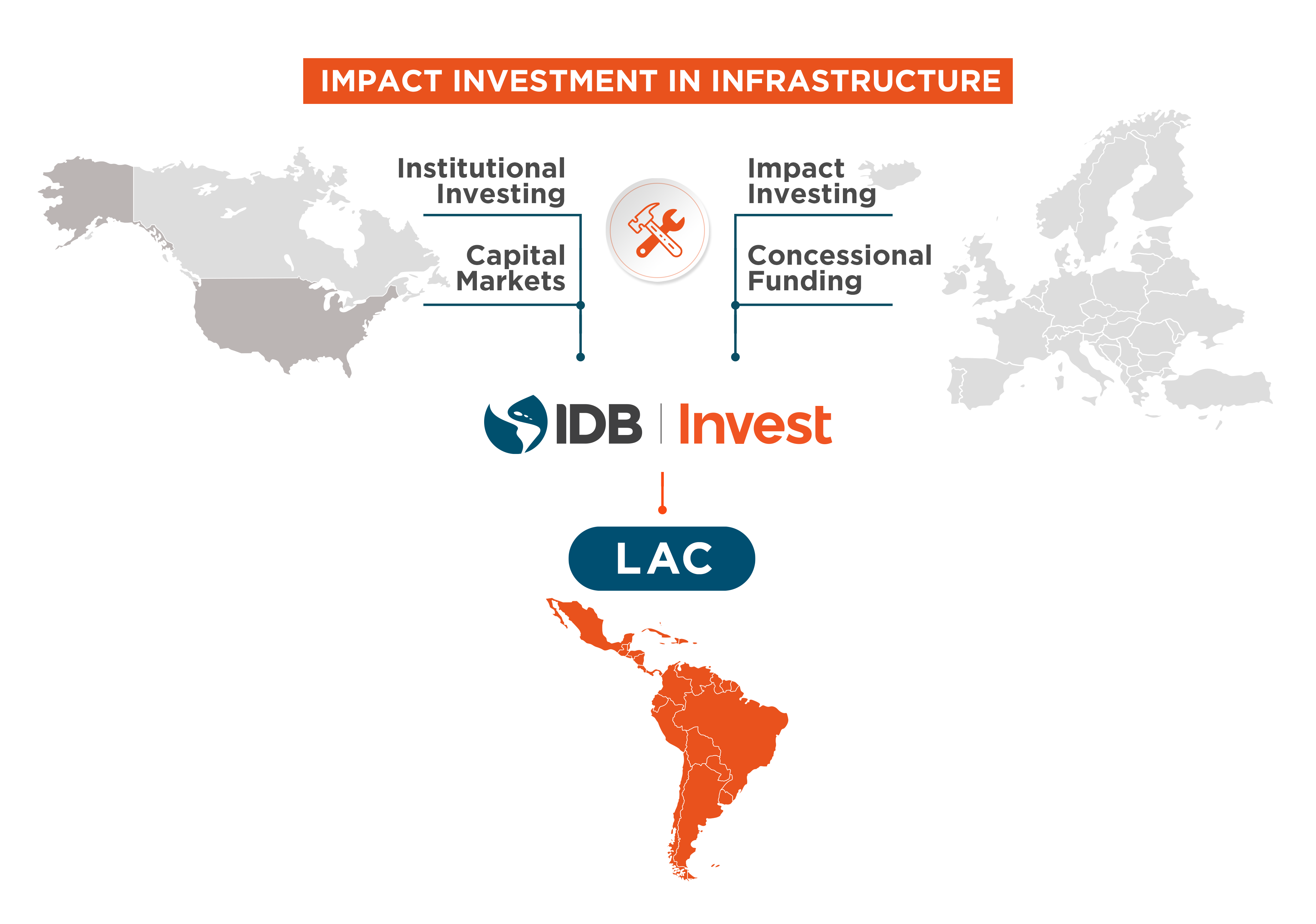
In that regard, the current infrastructure pipeline and thematic bonds are particularly promising to attract investors to the region. According to United Nations Sustainable Finance Hub, thematic bonds are traditional fixed income instruments which allow investors to finance specific investment themes such as climate change, health, food, education, access to financial services and target specific Sustainable Development Goals (SDGs) through investing.
IDB Invest’s participation in impact financings have provided a key catalytic effect to drive investors towards such bonds. This has been done in many forms, for example by providing a fixed amount to cover, say, a portion of the bond issuance, with the possibility of reducing the contribution if more liquidity is raised from other investors in the market. That is a tried-and-tested system that has allowed to raise funding from existing pockets of local liquidity and new accounts abroad. IDB Invest strong ESG practices and its in depth knowledge of the region are also part of our value proposition to investors that seek robust opportunities in LAC
Last year, for example, IDB Invest’s involvement helped secure local currency financing for the Rumichaca-Pasto toll-road, through the second social bond (thematic bond in which social benefits such as access to services, higher productivity, improved life conditions or gender measures are accounted as a benefit in the financing structure) issued in Colombia’s infrastructure sector and the largest ever in local currency, for an amount of 260 million in US dollars equivalent in Colombian pesos. IDB Invest anchored half of the issuance, and the rest of the bond was subscribed by local institutional investors, and also by a few new impact investors for the region, mainly from Europe and the US.
Another valuable example of an impact financing, also in Colombia, is the work done in Puerto Antioquia, mobilizing $390 million to close the financing of an entirely new port in Antioquia – a region that has been in need of commercial access by sea for three decades.
In this case, the design of a tailored integrity and reputational framework, partnering with a local expert as Financiera de Desarrollo Nacional (FDN), as well as the enforcement of the highest environmental and social standards was fundamental to secure impact investment in a critical, fragile environment such as Uraba. The innovative work performed in those areas allowed for investors to enter the transaction not only from the equity side (with well-known equity fund players and institutional investors) but also from the debt side, with local lenders in the senior tranche, and a global private equity firm in the mezzanine tranche, adding value and liquidity to the full financial plan.
Puerto Antioquia is expected to indirectly generate 17,000 jobs, while contributing to the region’s sustainable economic growth. An adequate management of integrity and environmental and social risks helped bring liquidity to this strategic project; and definitely opened the door to its refinancing through a capital markets solution in a near future, once construction is completed.
There’s been some debate on whether these projects are benefiting from a price perspective: market data is inconclusive about direct price incentives these projects might receive due to its developmental characteristics. Although there seems to be consensus that there is no direct impact in pricing, there is an undisputable additional liquidity, related to the increasing appetite towards sustainable projects. That liquidity might represent a benefit in itself, and supports the key objective of breaching the infrastructure gap, especially at a time when there are plenty of investment opportunities in a region rich in resources as well as human and natural diversity, like LAC.
In conclusion, there is a clear need for investment in the region, and at this moment there is a huge surge of sustainable/impact funds with appetite to invest in sustainable infrastructure. One important way to attract that investment to LAC is to structure sound deals with enhanced environmental, social and integrity frameworks, structured in a flexible and creative manner at the speed needed in the market. We believe that IDB Invest has a key catalytic role to play there, providing our sustainability seal to transactions, innovative financial structures and creating new partnerships to invest in our region. Stay tuned for more.
Authors

Rafael Matas
RAFAEL MATAS TRILLO is presently Head of the Andean Region and Energy Sector Lead, in the Infrastructure and Energy Division of IDB Invest, based at IDB Invest’s head-office. He has been working for the IDB Group since 2007, leading the development of transportation, renewable energy, transmission and water and sanitation transactions in Latin-America.
As Head of the Andean Region since 2020, Mr. Matas leads a team that has structured and financed paramount transactions such as Lima Airport, the Rumichaca-Pasto and Pamplona-Cucuta 4G toll-roads through social bonds, the first solar PV project finance transactions in Colombia, and the largest wind projects in Peru to date with Engie and Enel, among others.
He is presently also the Energy Sector Lead of IDB Invest, where he leverages on the experience and knowledge of the energy markets, obtained throughout the last 17 years helping countries to develop its PPA frameworks (such as Uruguay or the Dominican Republic), structuring numerous solar, wind and green transmission transactions (in Dominican Republic, Uruguay, Argentina, Chile, Brazil and Colombia), and designing innovative products such as the first Total Credit Guarantee from the IDB Group to wrap a debenture of infrastructure to finance a wind transaction in Brazil, or the IDB Invest Green Transmission Line Certificate.
A Spanish national, he has received awards for innovative project finance execution. Previous to the IDB Group, Mr. Matas worked for the Spanish bank Banco Bilbao Vizcaya Argentaria (BBVA) in its Hong Kong office for two years, managing the Spanish desk of the BBVA in China, and mainly devoting to corporate finance transactions.
He has a Law Degree and LLM by ESADE (Spain) and a Master in Foreign Service by Georgetown University.

Gabriel Azevedo
Luiz Gabriel Todt de Azevedo (Gabriel Azevedo) is the Managing Director of the Social Environmental and Governance Division of IDB Invest. During his 35+ year career in international development, the private sector, academia, and civil society, he has developed a unique perspective on strategic leadership, political economy, partnerships, and collective action. He has held various leadership positions, including seven years as Managing Director of the Environmental, Social and Corporate Governance (ESG) Division at IDB Invest. He has worked in development projects in more than forty-five countries, focusing on areas such as energy, water supply and sanitation, natural resource management, agribusiness, social innovation, and environmental management. He has worked in renowned institutions such as the World Bank, the World Wildlife Fund for Conservation (WWF), and Construtora Norberto Odebrecht.
Gabriel served as Board Member and Member of the Financing and Audit Committee of the Brazilian Biodiversity Fund (FUNBIO). He was Vice Presidente and President of Brazilian Water Resources Association (ABRHidro) and seats on its Consultative Board. He is also an observer to the Board of the International Hydropower Association (IHA). He has received numerous awards in recognition of his professional achievements. Additionally, he has published numerous articles, short papers, blogs, and book chapters in his field of expertise.
Gabriel is a civil engineer from the Federal University of Bahia in Brazil and holds a M.Sc. and a Ph.D. in Civil Engineering - Hydrology and Water Resources Management from Colorado State University.
LIKE WHAT YOU JUST READ?
Subscribe to our mailing list to stay informed on the latest IDB Invest news, blog posts, upcoming events, and to learn more about specific areas of interest.
SubscribeInvestment Funds
Related Posts
IDB Invest Cultivates Caribbean Fund Managers to Mobilize Private Capital
By training local fund managers and anchoring blended‑finance vehicles, IDB Invest mobilizes private capital for sustainable growth across the Caribbean.

Strengthening Impact Measurement and Management to Attract New Investors
To attract impact investors, fund managers increasingly recognize the need to measure and demonstrate the impact of their investments credibly. IDB Invest is working with fund managers in Latin America and the Caribbean to build their impact measurement and management capacity from the ground up.

Five Best Practices for Sustainable Bond Reporting
Enhancing transparency and accuracy, boosts investor confidence, and drives capital towards sustainable development.