
ESG: Due Diligence in the Age of Social Distancing
ESG due diligence must contend with a slew of challenges. However, inadequately fast-tracking of it runs the risk of short-changing clients from much needed value added and risks negative impacts to stakeholders and the environment.

In the era of the pandemic, business continuity has become fragile, supply chains have been disrupted and long- term economic stability is no longer certain. And yet, even in this time of difficulty, the private sector is committed to build their operations, execute their investments and support their workforce. Described as the “worst crisis since World War II,” the ILO (International Labour Organization) has estimated that COVID-19 will eliminate the equivalent of 14 million full-time jobs across Latin America and the Caribbean (LAC).
In a region where 30% of the population live below the poverty line (and close to 12% live in extreme poverty), many businesses in LAC (such as the hospitality, restaurant, manufacturing, retail, business and administrative sectors) are already experiencing severe impacts. Therefore, it goes without saying that the current crisis has amplified the relevancy of ESG (Environmental, Social and Governance) as a business opportunity –not just in safeguarding businesses for the present, but to prevent future recurrence and to promote pathways to recovery:
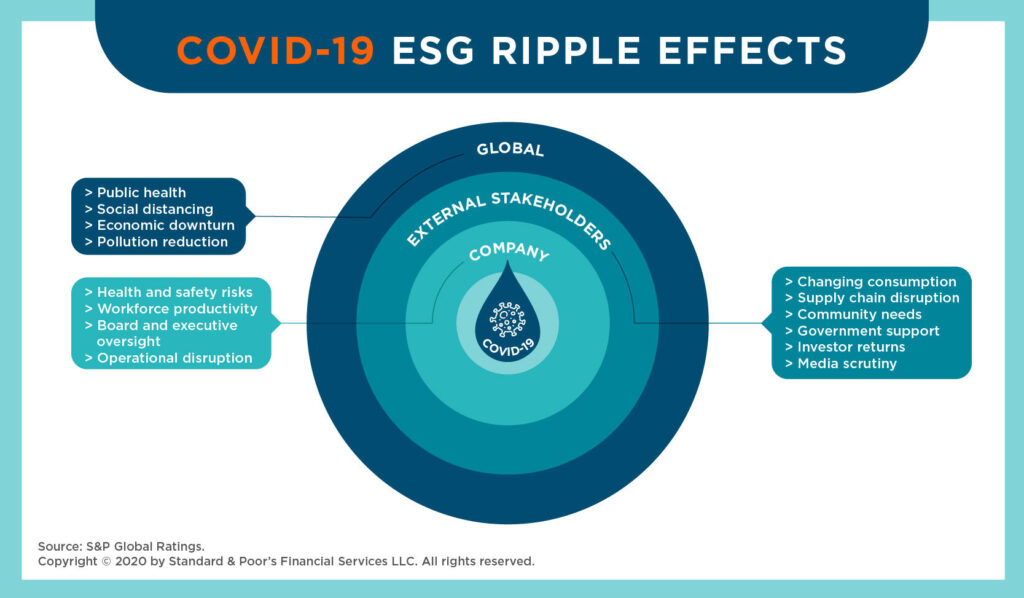
Under regular conditions, accounting for inherent non-financial risks routinely requires a focused human approach that often entails on-site visits with in-person meetings and interviews. Now that global travel restrictions and social distancing protocols have been put into place, ESG due diligence must contend with a slew of challenges including site access limitations, impediments to interviewing staff, difficulties to consulting with communities and stakeholders and delays in acquiring documents and conducting data collection and analyses.
As one can imagine, ensuring adequate project safeguards whilst maintaining business continuity is not an easy balancing act, since many operations (especially in the MSME space) will require financing. However, inadequately fast-tracking ESG due diligence runs the risk of short-changing clients from much needed value added and risks negative impacts to stakeholders and the environment.
Striking a balance
Fortunately, many clients in the region continue to embrace IDB Invest’s risk management procedures, even during these challenging times. A recent appraisal process conducted with Fernandes Group Enterprises (FGE) for the upgrade of the Guyana Demerara Bakery (DemBake) is a good case in point. For this operation, IDB Invest employed a virtual due diligence procedure and there were several aspects that contributed to an ultimately successful process, which included:
- Utilization of available technology: Free remote conferencing software such as Microsoft Teams, effectively connected multiple individuals from different countries. Having already reached 44 million daily active users, this software has been useful in bridging inherent gaps experienced with non-face-to-face interactions.
- Working with the local context: IDB Invest teams in both Guyana and Suriname were keenly informed about the countries’ circumstances and client background. This, added to previous site visits, sensitized the team to the cultural context and any ongoing changes on the ground (e.g. national COVID-19 measures, political situations, etc.).
- Building (and keeping) trust: Billed as a key aspect of effective communication, clear and open discussions between both parties were undertaken to inform on any queries and concerns in a responsive manner. As such, this practice was integral in keeping the momentum of discussions and flow of critical information needed to complete the appraisal process.
- Capitalizing on remote work: Teleworking is much more productive than contemporary procedures because generally there are no coffee breaks, participants are more punctual, there is less likelihood of absentees and meetings can be organized back to back (or in parallel, with different counterparts). In this situation, stakeholder fatigue was avoided because different groups from FGE were able to conveniently meet specific members the IDB Invest team without having to sit in on any unnecessary discussions or spend extra time finding locations splitting into separate groups.
- Observing time management: Teleworking among colleagues within different time zones under varying circumstances can be tricky. It is estimated that although remote employees work 1.4 more days per month, 29% of remote employees said they struggle with work-life balance. Therefore, limiting meetings to half-days, starting and ending them on time, allowing time for Q&As and providing follow ups via email were very helpful methods that ensured that everyone’s time was adequately used. Some additional guidelines of conducting a great teleworking experience can be found here.
- Using audiovisual data: Video support information about FGE’s proposed installations were provided to IDB Invest and presented a real representation of what is to be developed from financing. Maps, photos and plans also supplemented critical resources required to provide the appraisal team with a visual understanding of the project—especially in the absence of a physical site visit.
Given this good practice example, it’s is easy to see how this procedure can be applied across many projects to support current and future clients. However, it is important to note that while the FGE project was a great example of applying virtual ESG due diligence, not all projects are suited to the same. For instance, very high-risk projects will still require conventional appraisals that benefit from on-site visits and in person inspections.
Therefore, in a COVID-19 world innovative methods will have to be considered (e.g. use of in-country experts and even drones, etc.) to conduct appraisal (and supervision) tasks in-country. In addition, post-pandemic follow-up appraisal and supervision visits may also have to be implemented as needed.
IDB Invest has increased its support to the COVID-19 response (see useful infographic here) and has prepared several guidance documents to assist businesses and investors with the management of their projects during the COVID-19 pandemic. For more information, please visit IDB Invest’s sustainability website at https://idbinvest.org/en/sustainability which provides an ever- growing list of useful information for key sectors the region.■
Authors

Chitralekha Deopersad
Chitralekha Deopersad es oficial social y ambiental de BID Invest con sede en la Oficina de País de Jamaica. Trabaja con clientes del sector privado en América Latina y el Caribe en los requisitos de protección ambiental (ambiental, social, de salud y seguridad) en apoyo de la evaluación del proyecto y el cumplimiento de las normas locales e internacionales. También participa en la racionalización del cambio climático y la gestión del riesgo de desastres y la adaptación a proyectos del sector privado. En su capacidad anterior, apoyó al sector público dentro de la División de Cambio Climático y Sostenibilidad del BID en la Oficina de País de Bahamas. Chitralekha también fue científico ambiental / costero en Trinidad y Tobago durante varios años y tiene una maestría en ingeniería y gestión costera de la Universidad de West Indies, St. Augustine.

Paula Valencia
Paula Valencia is an environmental and social specialist at IDB Invest, based in Washington, D.C. and she leads the agribusiness group within the Environmental, Social and Corporate Governance Division. She is responsible for evaluating environmental and social impacts and risks of agribusiness operations, proposing mitigation measures consistent with international best practices, supervising the performance and sustainability of projects, offering technical assistance to customers and generating knowledge products. She has extensive experience in the public and private sectors of Latin America and the Caribbean, having worked with the IDB Group for more than 19 years, primarily in agribusiness, financial intermediation, and manufacturing projects. Paula is an Industrial Engineer from the Pontificia Universidad Javeriana (Colombia), she has a master's degree in environmental science and policy from Johns Hopkins University (United States) and other studies in agriculture from Cornell University (United States).
LIKE WHAT YOU JUST READ?
Subscribe to our mailing list to stay informed on the latest IDB Invest news, blog posts, upcoming events, and to learn more about specific areas of interest.
SubscribeFinancial Institutions
Related Posts

Governance and Succession: Securing the Future of Mexico’s Nonbank Financial Institutions
IDB Invest study: key findings and a roadmap to strengthen governance and CEO and senior management succession planning in nonbank financial institutions (NBFIs).
Facing the Storm: How IDB Invest Supports Caribbean Private Sector Resilience
IDB Invest is partnering with the Green Climate Fund to help Caribbean businesses better withstand future climate shocks through blended finance and technical assistance.

Reimagining the Future of Finance in Latin America and the Caribbean
At the FinnLAC Forum 2025 in Miami, the IDB Group hosted over 500 industry leaders and experts to help redefine the future of finance in Latin America and the Caribbean. The event focused on improving the ability of individuals and companies to better manage their finances, withstand economic shocks, and invest in their long-term prosperity. By highlighting innovations that broaden access, strengthen resilience, and promote overall financial health, the forum set the stage for more sustainable financial systems across the region.