
How’s the Digital Transformation of Agribusiness Going in the Region?
Agribusiness presents a great opportunity to increase value creation in a sector that is two to three times more effective at reducing poverty than any other, including manufacturing and services.


Agribusiness presents a great opportunity to increase value creation in a sector that is two to three times more effective at reducing poverty than any other, including manufacturing and services, according to a report on the progress of the digital transformation of agribusiness in Latin America and the Caribbean (LAC).
There was something in the IDB Invest report, developed in collaboration with Accenture, that caught our eye: our region accounts for 18% of the world's food production and only 10% of its economic value. These percentages indicate that digital technologies are the most efficient lever to address this key challenge for promoting development.
Achieving Digitalization through a Transformational Vision
The agribusiness sector is increasing its efficiency and production factor because of digital technologies. Additionally, the trend towards more sustainable practices and the reduction of precious resources, such as land, water and labor, make it imperative to find solutions that allow agribusinesses in LAC to compete with their products in international markets.
The study suggests that the digital transformation of agribusinesses in the region is still at an early stage. Most agribusiness chains have some degree of digitalization, often supported by legacy systems that have been adapted to meet specific needs and lack integration capabilities with other systems or a strategic perspective.
In summary, while agribusinesses in the region understand the benefits of digital technologies, they are still looking to develop a visio for digital transformation.
Six Challenges for a Digital Future
Based on digital maturity assessments and interviews with senior executives, the report identifies the top six challenges that agribusinesses face on their digital transformation journey.
Internal challenges:
- Fragmented strategic vision and lack of governance.
Organizations are not fully aligned, making it difficult to implement and reap the benefits of new digitally-driven initiatives.
- Inadequate budget and financing.
Insufficient resources to carry out digital transformation initiatives.
- Difficulty to acquire talent.
Employees in agribusinesses do not always have the soft skills or the digital readiness required to drive and understand the benefits of emerging transformation practices.
External challenges:
- Poor infrastructure and connectivity.
As most digital solutions require a stable internet connection, the lack of connectivity and poor infrastructure in the region limit the adoption of applicable technologies.
- Unstable ecosystem integration.
Integrating the agribusiness ecosystem actors is difficult, hindering the solution deployment and development that would benefit all.
- Supply-demand misalignment.
While there is a wide range of digital solutions, organizations state that they are not designed for their specific needs, making them incur excessive adaptation costs that hinder integration.
Digital Solution Benefits
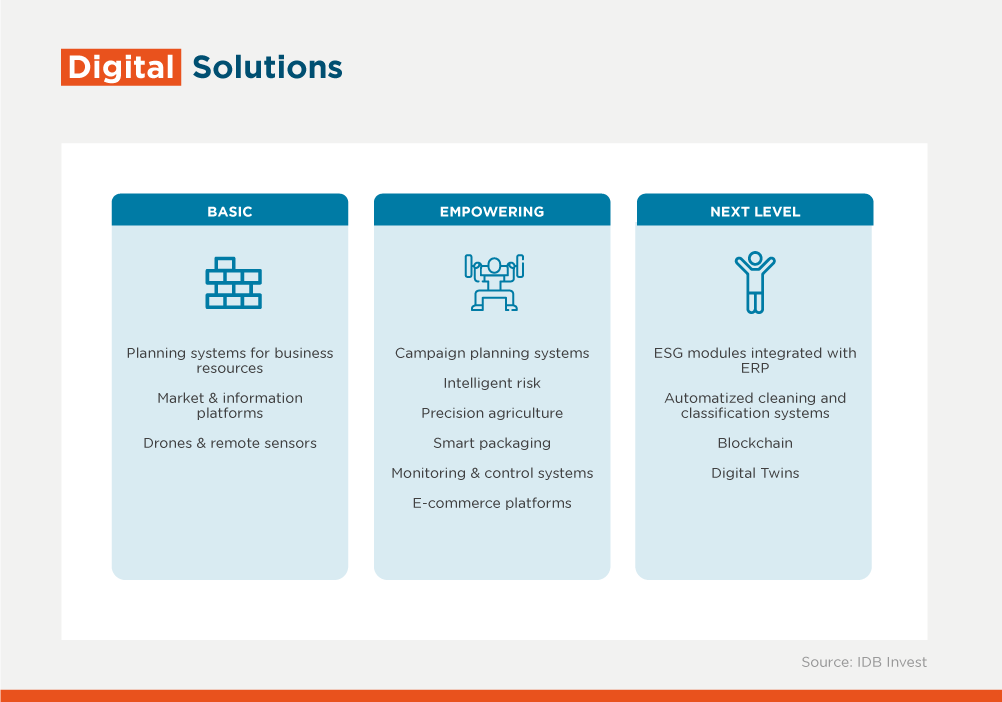
Digital solutions help agribusinesses be more efficient, productive, safe and environmentally friendly. They can be categorized based on their digital maturity level as Basic, Enabling and Next-level. However, the adoption level depends on the agribusinesses’ unique needs.
Basic solutions help to manage effectively an organization's resources and collect relevant data that can be leveraged to make better decisions.
Enabling solutions leverage the data generated along the value chain, helping organizations achieve higher levels of efficiency and productivity.
Next-level solutions can further boost an organization's productivity, helping it gain a considerable competitive advantage and get ahead of emerging market trends.
Regardless of the digital maturity level, a long-term vision and an ambitious digital transformation mindset are key for agribusinesses to reap the benefits of digital solutions.
A Path Toward Digital Transformation
Although the digital transformation challenges are not simple and rely on multiple variables, the report recommends some steps that agribusinesses can take to boost their digital maturity level.
- Discover: Set the business goal, a clear vision and specific objectives.
- Design and Plan: Promote a digital mindset, plan and design a digital strategy with robust governance practices.
- Assess: Develop a pilot to assess the assumption and the benefits before the final implementation.
- Scale-up: Classify the solution capabilities based on the pilot results and make changes as needed.
- Expand and Manage: Provide feedback on the tool after implementation and establish the best practices to evolve.
Although digital transformation is not a one-size-fits-all path, our study shows that it can help agribusinesses address the challenges and become key drivers of development in the region.
• Download the full report to learn more about these challenges and solutions.
• We have also created a course where you can learn how to apply proven best practices by global companies and make the most of digital transformation in your business.
• Access the report, the webinar we streamed about it and the on-line course here.
Authors

Guillermo Foscarini
Guillermo is currently the Managing Director and Chief of the Corporates Division for IDB Invest where he leads the origination and structuring of investments in the agribusiness, manufacturing, tourism and digital economy sectors totaling +$1.5B per year.
He joined the IDB Group in 2019 after spending almost 17 years at the International Finance Corporation, private-sector arm of the World Bank Group, where he held several senior investment and development banking positions as Principal Investment Officer in the Manufacturing, Agribusiness and Services & Credit Risk Departments.
Guillermo has worked on +150 corporate and project finance transactions, as well as equity and quasi-equity investments in Africa, Asia and Latin America & Caribbean totaling +$4.5B.
Guillermo holds a MSc in Risk Management from New York University (NY, USA), a MBA from Universidad del CEMA (Argentina), and a CPA degree from the Universidad Católica de Cordoba (Argentina).

Sung Nam Choi
Sung Nam Choi is a professional in IT projects for development. Before joining IDB Invest, he worked as a principal manager in the National Information Society Agency (NIA) of the Republic of Korea. He led IT projects for developing countries such as national digital agenda, broadband masterplan, e-government systems & applications, and digital inclusion policy. In addition, he conducted IT advisory services and managed IT training programs collaborating with international organizations like International Telecommunication Union (ITU), Asia-Pacific Telecommunity (APT), Asian Development Bank (ADB), African Development Bank (AfDB), and Inter-American Development Bank (IDB). Furthermore, he has 7 years of field experience in Nicaragua and Costa Rica. He launched the first virtual Spanish IT education platform (CEABAD, https://ceabad.com/, located in Nicaragua) for policymakers, experts, and college students in Latin America. He coordinated over 30 MOOC (Massive Open Online Course) including digital business, e-commerce, Fintech, Internet of Things, Cloud Computing, Artificial Intelligence, and Blockchain technology through this platform. He also served as the representative of the Office of KOICA (Korea International Cooperation Agency) in Costa Rica. He studied a Ph.D. in Public Administration at Korea University, earned a master’s degree in Public Administration from Yonsei University (Korea), and completed the Executive Education Program of Digital Transformation in Government at Harvard Kennedy School (USA).
LIKE WHAT YOU JUST READ?
Subscribe to our mailing list to stay informed on the latest IDB Invest news, blog posts, upcoming events, and to learn more about specific areas of interest.
SubscribeFinancial Institutions
Related Posts

Governance and Succession: Securing the Future of Mexico’s Nonbank Financial Institutions
IDB Invest study: key findings and a roadmap to strengthen governance and CEO and senior management succession planning in nonbank financial institutions (NBFIs).

Facing the Storm: How IDB Invest Supports Caribbean Private Sector Resilience
IDB Invest is partnering with the Green Climate Fund to help Caribbean businesses better withstand future climate shocks through blended finance and technical assistance.

Reimagining the Future of Finance in Latin America and the Caribbean
At the FinnLAC Forum 2025 in Miami, the IDB Group hosted over 500 industry leaders and experts to help redefine the future of finance in Latin America and the Caribbean. The event focused on improving the ability of individuals and companies to better manage their finances, withstand economic shocks, and invest in their long-term prosperity. By highlighting innovations that broaden access, strengthen resilience, and promote overall financial health, the forum set the stage for more sustainable financial systems across the region.