
Sustainable BusinessRecent posts
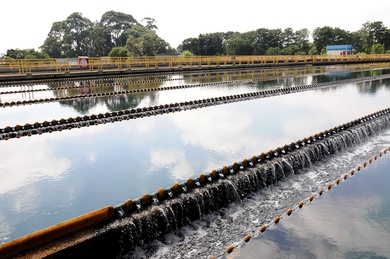
IDB Invest Structures the Largest Blue Bond in History: $1.35 Billion
The transaction supports the expansion of wastewater collection and treatment in the State of São Paulo and improves living conditions for 2.5 million people through an innovative financing solution.

Governance and Succession: Securing the Future of Mexico’s Nonbank Financial Institutions
IDB Invest study: key findings and a roadmap to strengthen governance and CEO and senior management succession planning in nonbank financial institutions (NBFIs).

Korea's Cutting-Edge Innovations to Transform Agribusiness in Latin America and the Caribbean
Discover how IDB Invest connects regional agribusinesses with leading innovators in Korea to accelerate smart agriculture, agritech, and sustainable growth.

PEDAL YOUR BIKE. 3 Rides for Sustainability. #COP20
Leaders from government, civil society and the private sector are gathered in Peru this week for the final days of the 20th session of the Conference of Parties (COP) to define the way forward on climate change. Bringing climate change to the world stage communicates the urgency of the issue. Many companies are already engaged, and some have even based their business models on green principles. Bicycles are one tool. Check out three rides for sustainability:
A Business Approach to Smallholder Agriculture
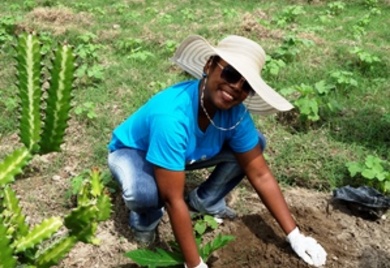
* By Andrea Sabelli There are an estimated 500 million smallholder farmers across the globe that produce food for over 2 billion people. These farmers work on plots of land that are under 2 hectares. The vast majority are poor and undernourished. Yet, the future role of smallholders in the food supply chain and as land stewards will be essential. By 2050, the global population is expected to grow by 2 billion. To meet food demand growth, FAO estimates that 90% of the increase in food demand will need to come from higher yields on existing farms, of which smallholders play a crucial role. Thanks to an example in Haiti, a business approach to smallholder agriculture may be what it takes for us to efficiently address demand.

Women’s Entrepreneurship Day: Smart companies, pay attention
On November 19, 2014, the United Nations launched Women’s Entrepreneurship Day. This day reminds me of a newspaper article I read eight years ago that changed my life. It stated that, although more Jamaican women (70 percent) than men were graduating from higher education institutions, they had a significantly higher unemployment rate -15.6percent and 5.7 percent respectively-. As a Jamaican woman then working her way through university, it marked my professional path forever.

The top 10 developing nations investing in clean energy
By: Agustín Cáceres The history of investing in clean energy in developed countries like Denmark, Spain or Germany is well known: big investments, subsidies, and an energy matrix that is much greener than that of other developed nations likes the US or Japan. However, developing nations represent a large and rapidly growing share of the world’s clean energy investment, according to Climatescope 2014, a country-by-country assessment, interactive report and index that offers the clearest picture yet of clean energy in 55 emerging markets in Africa, Asia, and Latin America and the Caribbean.
Getting Brazil Climate-Ready One Sector at a Time #CRinBrazil
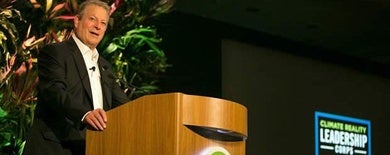
At the very time the city of São Paulo is struggling with the worst man-made water crisis in its history, with millions of people and local businesses suffering from water scarcity, climate leaders gathered in Rio de Janeiro just a few hundred miles away, to come up with solutions to the global climate crisis. I was one of 600 participants who came from 55 countries to attend Former U.S. Vice President Al Gore’s Climate Reality Project’s 26th leadership training, #CRinBrazil, the first one ever held in Latin America and the Caribbean.
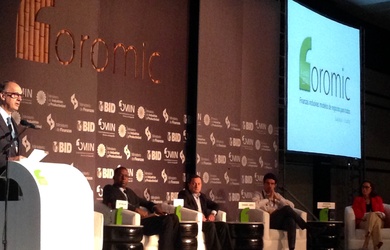
The evolution of impact investing: 6 signs of progress
Today experts from Latin America and the Caribbean gathered at the Foromic Conference in Guayaquil, Ecuador, to reflect on the evolution of impact investing. A recent JP Morgan and Global Impact Investing Network survey estimates there is at least $46 billion in impact investing assets under management globally, a figure expected to grow ten-fold in the next five years, according to predictions by the same institutions. The industry is especially relevant in emerging markets, where seventy percent of investment capital flows. This made today a timely moment of self-reflection to highlight how far impact investing has come and where it is going.
