
IDB Invest Cultivates Caribbean Fund Managers to Mobilize Private Capital
By training local fund managers and anchoring blended‑finance vehicles, IDB Invest mobilizes private capital for sustainable growth across the Caribbean.


The Caribbean has the potential to become a dynamic hub for business and investment. With the right financial structures in place, the region’s vibrant entrepreneurial ecosystems and untapped opportunities offer favorable conditions for sustainable growth. For this reason, IDB Invest has launched a program to cultivate homegrown fund managers that mobilize investment to drive development across the Caribbean.
Institutional investors have long cited challenges such as small and fragmented economies, weak institutions, and environmental vulnerabilities as reasons for limited engagement in the Caribbean. Yet these very challenges present unique opportunities for high-impact investment.
In response, IDB Invest launched its Caribbean Impact Manager Program, an initiative that cultivates homegrown fund managers specializing in private equity, private debt, and venture capital.
A New Chapter: The Caribbean Impact Manager Program
The Caribbean Impact Manager Program is IDB Invest’s strategic effort to grow the region’s private capital system by cultivating a new generation of local fund managers – through capacity building, investment, and ecosystem building. This initiative is aligned with the IDB Group's ONE Caribbean program, a regional approach to promoting sustainable development.
Strategic Capacity Building
We organize an annual masterclass to help emerging fund managers become ready for institutional investors. The first cohort of over 50 participants from 30 aspiring fund managers across 15 countries graduated from a three-day tailored training in Kingston, Jamaica. At the same time, we launched the IDB Invest Caribbean Fund Manager’s Toolkit – an open-source, DIY manual for emerging fund managers in the region. Building on the momentum, the next masterclass is set for the first half of 2026 in Barbados.
From Training to Investment: Seeding the Future
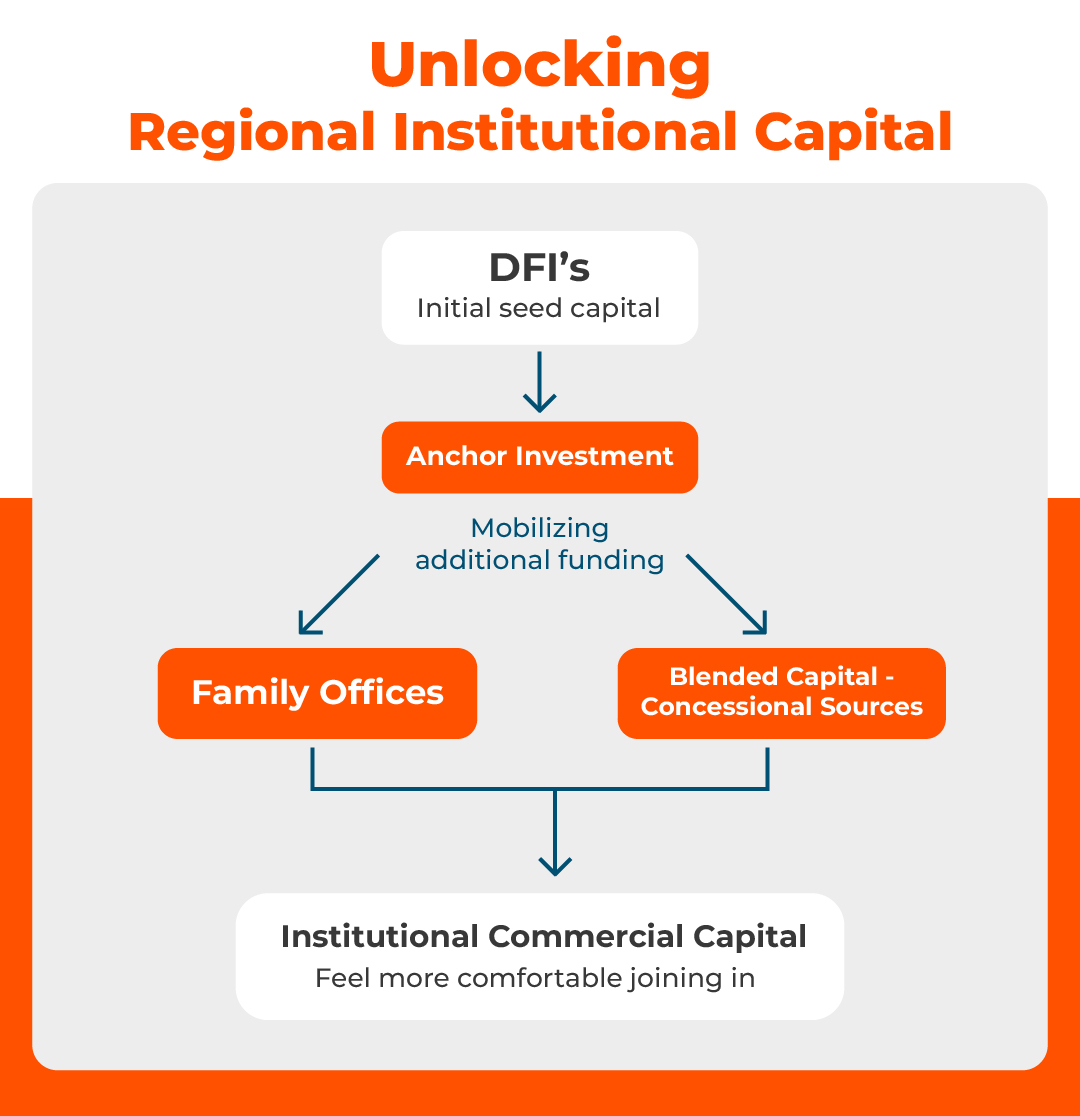
Training is just the starting point. Through the Caribbean Impact Manager Program, IDB Invest also makes anchor investments – early, cornerstone commitments to the most promising funds. While development finance Institutions (DFIs) can plant the initial seed capital, mobilizing additional funding is essential to complete rounds of capitalization.
A central part of this effort is unlocking regional institutional capital. Advancing this requires working closely with regulators to enable local pension funds to invest across the Caribbean. It also means partnering with mission-driven family offices and concessional funding sources to complete the capital structure by incorporating catalytic, first-loss blended capital. Engaging these funds, which are initially willing to take higher risks, helps other investors feel more comfortable joining in.
The recent $94 million first close of the Caribbean Community Resilience Fund (CCRF) is a perfect example of regional capital mobilization to maximize impact. Managed by Sygnus Capital and anchored by IDB Invest – whose participation includes blended finance resources provided under the United Kingdom Sustainable Infrastructure Program (UKSIP) – alongside the CARICOM Development Fund, philanthropic investment organization Allied Climate Partners, the Caribbean Development Bank, local pension plans, and several family offices, CCRF is harnessing blended finance to invest in regional climate and economic resilience companies, projects, and platforms. CrossBoundary also acted as an advisor to Sygnus Capital.
Despite a challenging fundraising environment, the combination of a strong manager, an innovative structure, and a committed group of anchor investors enabled the fund to mobilize support from regional pension funds, philanthropic institutions, and family offices. This achievement is a powerful example of what’s possible when vision is backed by action. Encouragingly, a healthy pipeline of next generation fund management talent is already taking shape.
Building the Ecosystem: One Step at a Time
A key pillar of the IDB Invest Caribbean Impact Manager Program is ecosystem building, which leverages close cooperation with other IDB Group windows, including the public-sector arm, IDB, and its innovation arm, IDB Lab. In partnership with local industry associations – such as the Caribbean Alternative Investment Association (CARAIA) – and other regional partners, IDB Invest hosts the regional IDB Invest Caribbean Series and collaborates with public-sector institutions. Spearheading efforts to modernize the region’s investment regulation and harmonize legal investment structures creates more opportunities for private investment.
Our commitment to the Caribbean is unwavering. We’re laying the groundwork for a resilient, sustainable private capital sector – step by step, initiative by initiative.
Authors

Lucas de Beaufort
Lucas de Beaufort is a Principal Investment Officer for the Investment Funds team at IDB Invest, where he invests in private equity funds and multi-sector debt throughout Latin America and the Caribbean. Lucas has more than 25 years of experience in debt and equity in Latin America. Before joining the IDB Group in 2019, he was responsible for raising and investing the Central American Mezzanine Infrastructure Funds (CAMIF I & II) in LAP Latin American Partners. Lucas also served as Head of Investor Relations. He previously co-managed a $1 billion Latin infrastructure fund at EMP Global. Prior to that, he was Investment Officer for Latin America at the Dutch development bank FMO. Lucas completed a Master's degree in Corporate Law from Leiden University in the Netherlands and a Master's degree in International Economics and Latin American Studies from the Johns Hopkins School of Advanced International Studies (SAIS), where he was a Fulbright scholar.
LIKE WHAT YOU JUST READ?
Subscribe to our mailing list to stay informed on the latest IDB Invest news, blog posts, upcoming events, and to learn more about specific areas of interest.
SubscribeGender
Related Posts
Digital Innovation Expands Financing for Women-Led SMEs in Latin America and the Caribbean
Loans and disbursements approved in less than 24 hours, enabled by artificial intelligence, and early invoice payments powered by fintech solutions are transforming access to credit for MSMEs, especially those led by women.

Fixing the Broken Rung: How Data Can Help Advance Women’s Careers in Latin America and the Caribbean
In Latin America and the Caribbean (LAC), the greatest disruption in women’s career progression occurs during the transition into managerial roles. A collaboration between IDB Invest and LinkedIn, within the framework of the Development Data Partnership, uses large-scale labor-market data to identify where women’s participation declines and what barriers exist across sectors and career stages.

Addressing gender-based violence from the private sector: the experience of Laboratorios Bagó
Francisco Méndez, CEO of the pharmaceutical company, shares his company's efforts and achievements in fostering an inclusive and safe work environment.